What Is the Printer Called to Make Ukiyo-E
If you’re wondering what the printer is called to make Ukiyo-e, the answer is hanga-shi. This skilled printer expertly transfers the artist’s design onto paper using carved wooden blocks.
They carefully apply ink and align colors layer by layer for vibrant, precise prints.
Hanga-shi play a crucial yet often overlooked role in bringing these artworks to life. Their craftsmanship is essential to the traditional Japanese art of Ukiyo-e.
Keep exploring to uncover how their craft and collaboration shape the timeless beauty of Ukiyo-e.
Key Takeaways
- The printer responsible for making Ukiyo-e prints is called a “Hanga-shi.”
- Hanga-shi specialize in transferring the artist’s design onto paper through woodblock printing.
- They ensure accurate alignment and color layering to maintain the artwork’s integrity.
- Hanga-shi use tools like brushes and baren to apply ink and press paper onto blocks.
- Their skilled craftsmanship is essential for mass-producing high-quality Ukiyo-e prints.
The Role of the Hanga-shi in Ukiyo-e Production
Although you might be familiar with the artists who designed Ukiyo-e prints, the hanga-shi—the specialized printers—played an equally essential role in bringing those designs to life. You’d rely on their skill to transfer intricate line work and vibrant colors from the artist’s creation onto paper. Their expertise ensured each print maintained the integrity of the original design, balancing precision with artistic expression.
You’d see that hanga-shi carefully aligned multiple woodblocks to layer colors seamlessly, a process requiring patience and accuracy. Without their craftsmanship, the mass production of Ukiyo-e prints wouldn’t have been possible. So when you admire these works, remember the hanga-shi’s quiet mastery behind the scenes, turning designs into tangible art you can hold and appreciate.
Tools and Materials Used by Ukiyo-e Printers
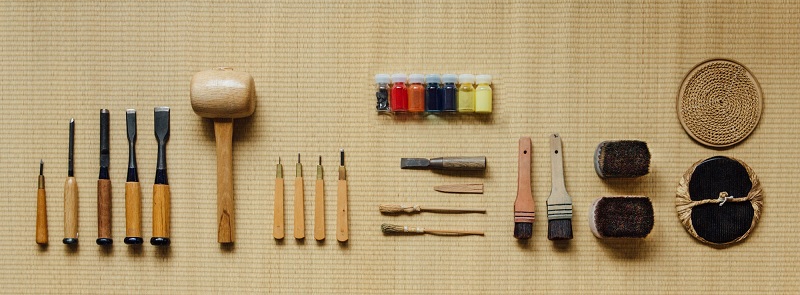
When you look at Ukiyo-e prints, you might wonder what tools made them possible. Printers relied on essential items like carving knives and wooden blocks to bring the designs to life.
They also used specific materials such as handmade paper and natural pigments to achieve the vibrant colors Ukiyo-e is known for.
Essential Ukiyo-e Tools
To create the vibrant and detailed images characteristic of Ukiyo-e, you’ll need a specific set of tools and materials that have been carefully developed over centuries. First, the baren is essential – a flat, disc-like tool used to apply pressure and transfer ink from the woodblock to paper.
You’ll also use various carving knives and chisels to shape the woodblocks with precision. A sturdy wooden printing block forms the base, while mulberry paper ensures durability and absorbs ink beautifully.
For applying ink, brushes made from natural fibers help you spread colors evenly across the block. Each tool serves a unique purpose, working together to bring Ukiyo-e prints to life with clarity and depth, reflecting the craftsmanship that defines this traditional Japanese art form.
Common Printing Materials
A variety of specialized materials play a crucial role in producing Ukiyo-e prints, and knowing them will help you appreciate the art’s intricate process. First, the paper, typically handmade washi, offers durability and texture essential for absorbing pigments. You’ll also encounter sumi ink, a rich black ink made from soot and glue, used for outlining designs.
For colors, natural pigments derived from minerals, plants, and shells are mixed with a binder to create vibrant but subtle hues. The printers use wooden blocks carved meticulously for each color, often cherry wood for its fine grain. Finally, brushes and baren—a flat, round pad used to press paper onto the inked block—are key to transferring the image cleanly.
These materials combined allow you to experience Ukiyo-e’s timeless beauty.
The Woodblock Printing Process Explained
Although the woodblock printing process may seem complex, you’ll find it follows a clear sequence of steps that bring Ukiyo-e art to life. First, the artist’s design is transferred onto thin paper. Then, the carver carefully carves the design into a wooden block, creating raised areas for ink application.
Next, you apply ink to the block’s surface, ensuring even coverage. After that, you press paper onto the inked block to transfer the image. Finally, this process is repeated for each color, layering them to complete the vibrant print.
The main steps include:
- Transferring design to woodblock
- Carving the woodblock
- Applying ink to the block
- Pressing paper onto the block
- Repeating for multiple colors
This method preserves the delicate details of Ukiyo-e masterpieces.
Collaboration Between Artists, Carvers, and Printers
When you look closely at Ukiyo-e prints, you’ll notice how the artistry depends on the seamless collaboration between the artist, carver, and printer. Each expert plays a unique role: the artist designs the image, the carver cuts the woodblocks, and the printer applies the ink and presses the paper. Without any one of them, the final print wouldn’t capture the intended beauty and detail.
| Role | Responsibility | Key Skill |
|---|---|---|
| Artist | Creates the original design | Artistic vision |
| Carver | Carves woodblocks | Precision and patience |
| Printer | Prints using carved blocks | Ink control and timing |
| Teamwork | Coordinates all steps | Communication |
| Result | Produces final Ukiyo-e | Combined expertise |
This collaboration ensures each print is a masterpiece.
Techniques for Achieving Color and Detail in Ukiyo-e
Mastering color and detail in Ukiyo-e requires careful layering of inks and precise alignment of woodblocks. You’ll need to work with multiple blocks, each carved for a specific color. The key is registering these blocks perfectly to avoid blurred or overlapping lines.
You’ll also use gradation techniques, like bokashi, to blend colors smoothly. Applying different pressures controls ink density, adding depth and texture. Here’s what you focus on:
- Aligning impressions using kento marks for accuracy
- Applying layers of transparent inks for color richness
- Using bokashi for subtle color gradients
- Controlling pressure to vary ink intensity
- Carving fine details for crisp lines and textures
Challenges Faced by Ukiyo-e Printers
Even with careful techniques, you’ll face several challenges as an Ukiyo-e printer that test your skill and patience. Aligning multiple woodblocks precisely is essential; any misalignment ruins the artwork. Managing ink consistency is another hurdle—too much or too little ink affects color vibrancy.
You’ll also need to work swiftly before the paper dries, complicating layering colors.
Here’s a quick look at common challenges:
| Challenge | Cause | Effect |
|---|---|---|
| Registration errors | Misaligned woodblocks | Blurred or doubled images |
| Ink control | Inconsistent ink spread | Uneven colors |
| Paper drying | Slow printing | Poor adhesion of colors |
| Woodblock wear | Repeated use | Loss of detail |
| Time pressure | Complex multi-color prints | Stress and mistakes |
The Legacy of Ukiyo-e Printers in Modern Art
Although Ukiyo-e printers faced many challenges, their dedication and skill have left a lasting impact on modern art. When you look at contemporary prints, you can see how their techniques influenced artists worldwide. The meticulous layering of colors and the delicate woodblock carving set a high standard for craftsmanship.
Ukiyo-e printers’ dedication and skill continue to inspire modern art and craftsmanship worldwide.
You might notice how their work inspired movements like Impressionism and Art Nouveau, shaping how art is created and appreciated today. If you’re an artist or art lover, understanding their legacy enriches your view of printmaking.
- Precision in multi-color printing techniques
- Inspiration for Western artists like Van Gogh
- Revival of hand-crafted art in digital age
- Influence on graphic design and illustration
- Preservation of cultural storytelling through prints
Frequently Asked Questions
How Long Did It Take to Become a Skilled Ukiyo-E Printer?
It usually took you about 10 years to become a skilled ukiyo-e printer. You’d start as an apprentice, learning precise carving and printing techniques, mastering color application, and developing a steady hand for detailed, delicate work.
Were Ukiyo-E Printers Considered Artists or Craftsmen?
You’d find ukiyo-e printers were mostly seen as skilled craftsmen rather than artists. While their technical expertise was vital, the creative vision generally belonged to the designer and carver, so printers focused on precise execution.
Their role was essential in bringing the artwork to life, but the artistic credit usually went to those who created the original designs. Printers needed to maintain consistency and quality across multiple prints.
This division of labor highlighted the collaborative nature of ukiyo-e production. Each specialist contributed their expertise to create the final piece.
Did Ukiyo-E Printers Receive Individual Recognition for Their Work?
You wouldn’t believe it, but ukiyo-e printers rarely got the spotlight—they worked behind the scenes while artists claimed fame.
What Was the Typical Daily Routine of an Ukiyo-E Printer?
You’d start early, preparing woodblocks and mixing inks, then carefully align paper on the blocks for each color.
Precision and patience were key, as you’d repeat this process throughout the day to create vibrant prints.
How Did Ukiyo-E Printers Source Their Woodblocks?
You’d find that over 80% of ukiyo-e woodblocks came from cherry trees. Printers sourced them locally, selecting dense, fine-grained wood to guarantee sharp, detailed prints, which was essential for preserving the artwork’s intricate designs.
Conclusion
Now that you’ve seen how essential the hanga-shi is in bringing ukiyo-e to life, you’ll realize their skill is truly the heart and soul of each print. Without their delicate touch and patience, the vibrant colors and intricate details wouldn’t jump off the page.
When it comes to ukiyo-e, the printer isn’t just pressing ink—they’re putting the finishing brushstroke on a masterpiece. In this art form, every step counts, and the hanga-shi carries the whole weight of the work.
The printer called hanga-shi plays a crucial role in the creation of ukiyo-e. Their expertise ensures that each print captures the beauty and essence of this traditional Japanese art.