Who Invented Printer Machine
Who invented the printer machine is a question with a rich history behind it. You might think a single person invented the printer machine, but it actually evolved over centuries.
Johannes Gutenberg kickstarted it with his 15th-century movable metal type press, making printing faster and cheaper.
Later, the typewriter and early mechanical printers added precision and speed. In the 20th century, innovators like Chester Carlson and Gary Starkweather revolutionized it further with xerography and laser printing.
If you explore more, you’ll discover how these breakthroughs shaped today’s versatile printers.
Key Takeaways
- Johannes Gutenberg invented the movable metal type printing press in the 15th century, revolutionizing printing efficiency and accessibility in Europe.
- Early mechanical printers in the 19th century introduced gears and levers to automate ink transfer onto paper, paving the way for modern printers.
- Christopher Latham Sholes invented the typewriter in 1868, influencing mechanical printing with standardized fonts and improved text formatting.
- Chester Carlson invented xerography, foundational for photocopiers and laser printers, significantly advancing printing speed and quality.
- Gary Starkweather developed the laser printer, enhancing printing efficiency and quality for modern office environments.
The Origins of Printing Technology
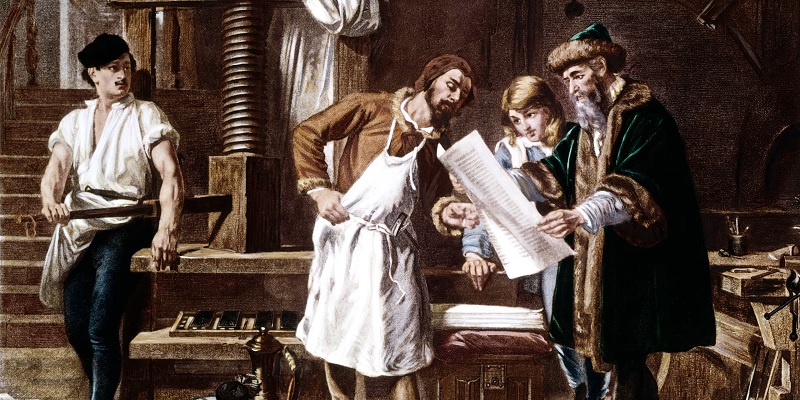
Although printing technology seems commonplace today, its origins date back centuries and laid the foundation for modern printers. You might not realize that before machines, people relied on hand-copying texts, which was slow and prone to errors. Early civilizations, like the Chinese, developed woodblock printing around the 9th century, carving entire pages onto wooden blocks to press ink onto paper.
This method let them reproduce texts more efficiently but was still labor-intensive. Later, movable type emerged in East Asia, allowing individual characters to be rearranged and reused, speeding up the process. These innovations weren’t just about printing—they revolutionized how information spread, making books and knowledge more accessible.
Understanding these beginnings helps you appreciate the complex journey that led to the sophisticated printer machines you use today.
Johannes Gutenberg and the Printing Press
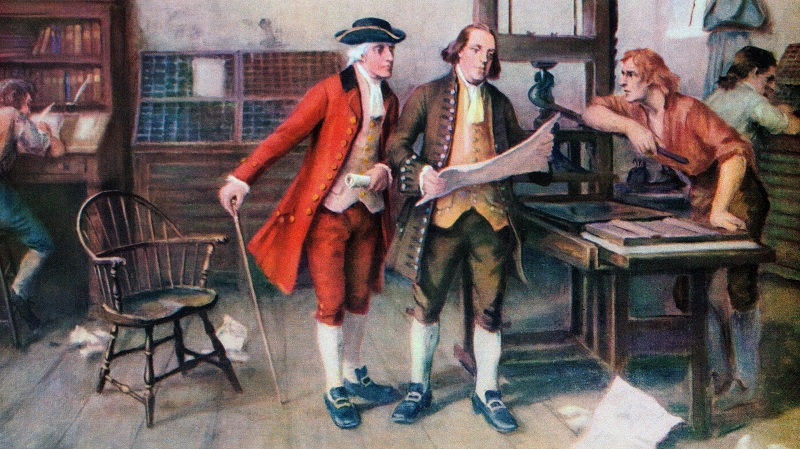
Building on the early printing methods from East Asia, Johannes Gutenberg took a big leap forward in the 15th century by inventing the movable metal type printing press in Europe. This innovation made printing faster, cheaper, and more accessible, transforming how information spread.
When you think about it, Gutenberg’s press allowed books to be mass-produced, breaking the monopoly of hand-copied manuscripts.
Here’s a quick overview of his invention’s key features:
| Feature | Description | Impact |
|---|---|---|
| Movable Type | Reusable metal letters | Efficient text composition |
| Printing Press | Mechanical ink application | Consistent print quality |
| Paper Usage | Standardized sheets | Lowered production costs |
You can see why Gutenberg’s press is often called the start of the printing revolution.
The Invention of the Typewriter
You might be surprised to learn how early typewriter models paved the way for modern printing technology. Inventors like Christopher Latham Sholes, who patented his design in 1868, played a key role in this development.
Let’s explore how these innovations changed the way we produce printed text.
Early Typewriter Models
Before typewriters became common office tools, inventors had already been experimenting with various early models designed to speed up writing. You’d find these early devices quite different from what you know today. Some resembled bulky mechanical contraptions with complex levers, while others used keyboard-like layouts.
They aimed to replace handwriting with a faster, more legible alternative. Though many of these models weren’t practical for widespread use, they laid the foundation for future improvements. You’d notice efforts to solve issues like key jamming and ease of use, which were common challenges back then.
These experiments showed how inventors were enthusiastic to create a machine that could reliably produce text, a goal that ultimately led to the typewriters you’d later see in offices everywhere.
Key Inventors and Dates
Inventors didn’t stop at early, bulky writing machines—they pushed forward to create more practical devices that could truly transform how you write. Christopher Latham Sholes is often credited as the key inventor of the typewriter. In 1868, he, along with Carlos Glidden and Samuel Soule, patented the first practical typewriter.
Their design introduced the QWERTY keyboard layout, which you still use today. Around the same time, other inventors like Giuseppe Ravizza and Peter Mitterhofer also worked on typewriting devices, but Sholes’ model gained commercial success first. The Sholes and Glidden typewriter was marketed in 1874 by E. Remington and Sons, marking the device’s commercial debut.
Knowing these dates and names helps you appreciate how the typewriter evolved into a tool that revolutionized writing efficiency.
Impact on Printing Technology
Though the typewriter was initially designed to improve writing speed and legibility, its invention had a profound impact on printing technology as well. You’ll find that the typewriter introduced mechanical precision and standardized fonts, influencing how printed materials were produced. It paved the way for advancements in automated printing and text formatting.
| Aspect | Before Typewriter | After Typewriter |
|---|---|---|
| Writing Speed | Slow, manual | Faster, mechanical |
| Font Consistency | Handwritten, varied | Standardized, uniform |
| Printing Accuracy | Prone to errors | Improved precision |
| Text Formatting | Limited, manual | Automated, more flexible |
| Production Process | Labor-intensive | More efficient, scalable |
You’ll see how this shift helped printing technology evolve rapidly.
The Development of Early Mechanical Printers
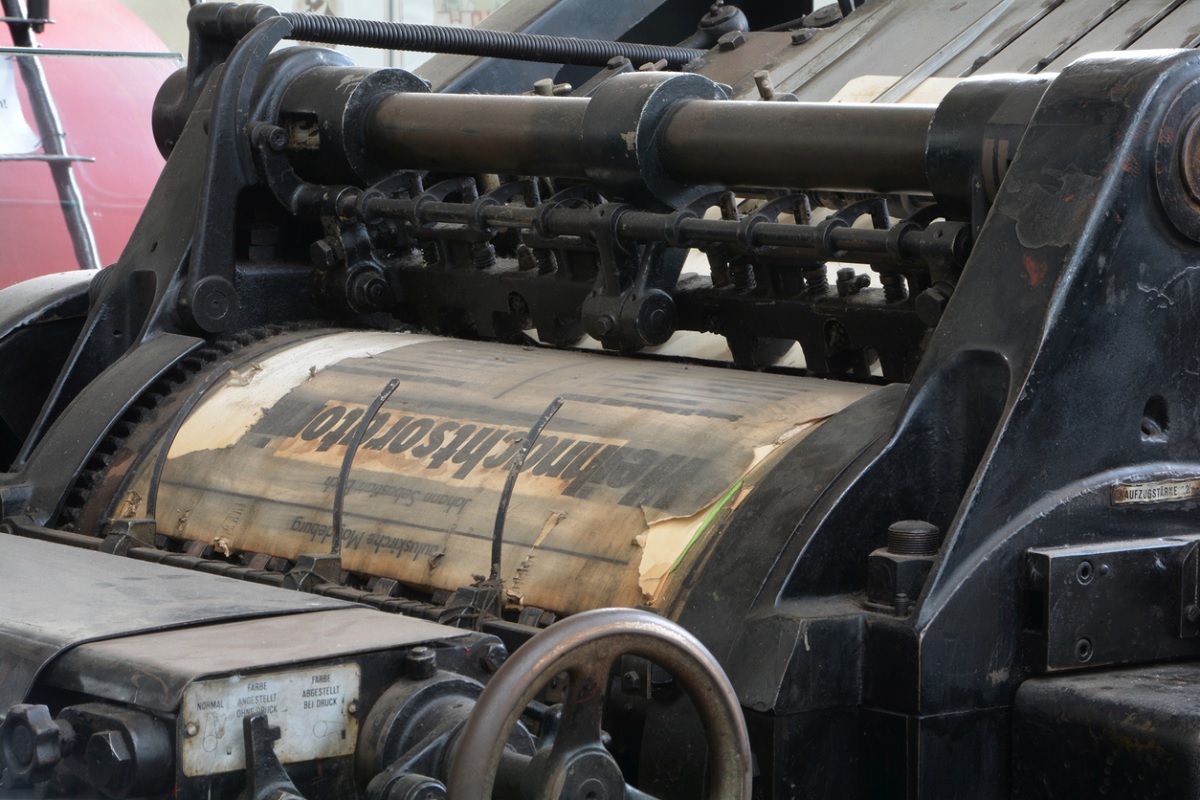
When you look back at the earliest mechanical printers, you’ll find they laid the groundwork for the devices we use today. These printers, emerging in the 19th century, relied on intricate gears and levers to transfer ink onto paper. You’d see innovations like the typographer’s movable type system integrated with mechanized processes, making printing faster and more consistent than manual methods.
One notable example is the development of the drum printer, which allowed multiple characters to be printed simultaneously. As you explore these early machines, you realize they emphasized precision and repeatability, vital for mass communication. Understanding their design helps you appreciate how mechanical ingenuity paved the way for modern printing technology, turning complex manual tasks into automated, efficient printing solutions.
The Rise of Inkjet and Laser Printers
You’ve probably noticed how inkjet and laser printers changed the way we print at home and work. Inkjet technology brought detailed color printing, while laser printers introduced speed and efficiency.
Let’s explore how these innovations reshaped the entire printing industry.
Inkjet Technology Development
How did inkjet technology revolutionize the way we print at home and in offices? It made high-quality color printing affordable and accessible. Unlike older methods, inkjet printers spray tiny droplets of ink directly onto paper, letting you get sharp images and vibrant colors without expensive equipment.
You don’t need bulky machines or complex setups; inkjet printers are compact and user-friendly, perfect for personal and small business use. This technology also allowed for faster printing of photos and documents with rich detail. Over time, improvements in ink formulations and print head designs have enhanced reliability and print speed, making inkjet printers a staple in many homes and workplaces.
Laser Printer Innovation
Although inkjet printers transformed home and office printing, laser printers brought a new level of speed and efficiency that changed the game for businesses and heavy users. When you use a laser printer, you’re benefiting from technology that uses a laser beam to produce high-quality text and graphics quickly. This innovation made large-volume printing more accessible and economical.
Here’s what sets laser printers apart:
- Precision: Lasers create sharp, clear text and images with consistent quality.
- Speed: You get faster printouts, ideal for busy offices or large print jobs.
- Cost-effectiveness: Although initial costs can be higher, the per-page cost is lower over time.
Impact on Printing Industry
Laser printers revolutionized how businesses handle large print volumes, but inkjet technology also reshaped the industry by offering affordable, high-quality color printing for everyday users. When you look at your home or office printer, chances are it’s either inkjet or laser. Inkjet printers let you produce vibrant photos and detailed graphics without breaking the bank, making color printing accessible.
On the other hand, laser printers excel in speed and efficiency, which is why offices rely on them to churn out documents quickly. Together, these technologies expanded printing capabilities beyond just black-and-white text. So, whether you need crisp reports or colorful images, the rise of inkjet and laser printers means you’ve got the right tool at your fingertips, boosting productivity and creativity across the board.
Key Innovators in Modern Printing Technology
When you consider the printers we use today, it’s clear that modern printing technology owes a lot to key innovators who transformed early concepts into the efficient machines we rely on. You’ll find that these pioneers pushed boundaries, blending creativity with engineering to revolutionize printing.
- Charles Babbage: Though better known for computing, his mechanical ideas influenced early printer designs.
- Chester Carlson: Invented xerography, the foundation for photocopiers and laser printers you use daily.
- Gary Starkweather: Developed the laser printer, drastically increasing speed and quality in office printing.
Understanding these figures helps you appreciate how their breakthroughs made printing faster, cleaner, and more accessible, shaping the digital age’s communication landscape.
Frequently Asked Questions
What Materials Are Commonly Used in Modern Printer Ink?
You’ll find modern printer ink usually contains water, colorants like dyes or pigments, and various additives for flow and drying. These materials help ink stick well and produce vibrant, clear prints on different paper types.
How Do 3D Printers Differ From Traditional Printers?
Like stepping into the future, you’ll see 3D printers build objects layer by layer, unlike traditional printers that only apply ink on flat paper.
You’re fundamentally creating real, touchable designs instead of just images or text.
What Are the Environmental Impacts of Printing Technology?
You’ll find printing technology impacts the environment through energy use, waste from cartridges, and paper consumption. However, digital alternatives and recycled materials can help reduce these effects, making your printing habits more eco-friendly.
How Does Wireless Printing Work?
Wireless printing works by connecting your device to a printer via Wi-Fi or Bluetooth. You send print commands over the network, and the printer receives them without cables, making printing more convenient and flexible for you.
This eliminates the need for physical connections, allowing multiple devices to print to the same printer. Wireless printing supports mobility and ease of access in both home and office environments.
What Maintenance Is Required for Home Printers?
You’ll need to regularly clean print heads, replace ink or toner, and keep paper trays dust-free. Also, update your printer’s software and avoid leaving it unused for long to prevent clogs and maintain print quality.
Regular maintenance helps ensure your printer runs smoothly and produces high-quality prints. Checking for paper jams and using the correct paper type are also important.
Don’t forget to run diagnostic tests if your printer offers them, as this can help identify issues early. Storing your printer in a clean, dry place can extend its lifespan.
Conclusion
As you look at the printer humming quietly on your desk, remember it’s more than just a machine—it’s a bridge from Gutenberg’s first press to today’s sleek devices. Like a river flowing through time, innovation has carried printing from clunky beginnings to the smooth, rapid art it is now.
Every page you print holds the legacy of countless inventors who turned imagination into ink and paper into possibility. The invention of the printer machine revolutionized communication and knowledge sharing. From Gutenberg’s pioneering press to modern printers, each advancement builds on the last.
Understanding who invented the printer machine helps us appreciate this journey of innovation and the technology we often take for granted.